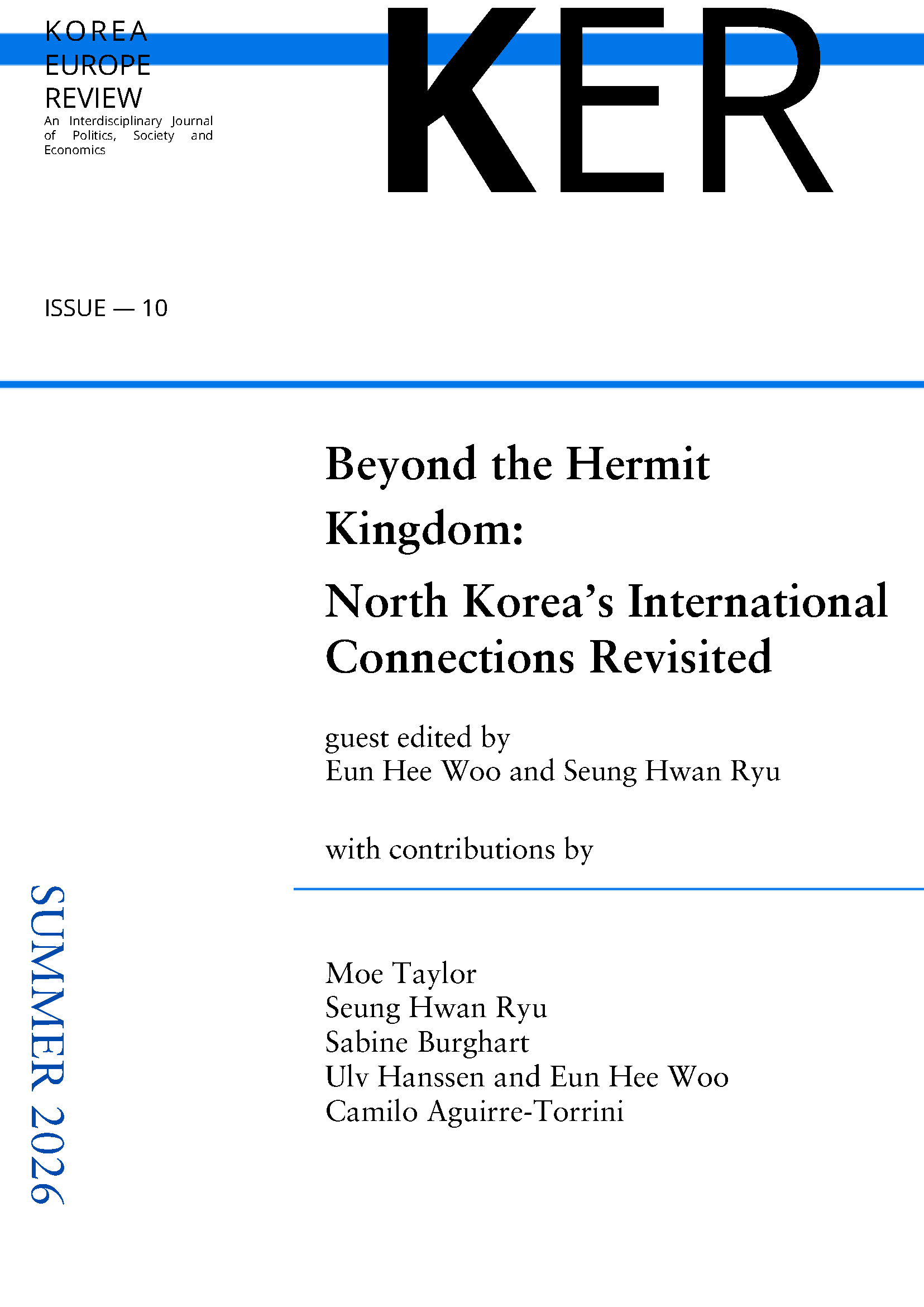
The Unmaking of South-South Cooperation
North Korea-Africa Agricultural Collaboration and the Decline of the Global South
DOI:
https://doi.org/10.48770/ker.2026.no10.76Keywords:
South-South Cooperation, Collective Self-reliance, Global South, New International Economic Order, Non-Aligned MovementAbstract
This article examines North Korea’s agricultural cooperation with African countries during the Cold War, focusing on the global circumstances that shaped both its expansion and its subsequent decline following the adoption of the Joint Venture Law in 1984. Since the 1950s, North Korea cultivated anti-imperialist solidarity with postcolonial African states as part of its broader pursuit of international recognition. During the 1970s and 1980s, Pyongyang promoted agricultural cooperation as a practical expression of collective self-reliance and food sovereignty. Departing from previous studies that attribute the collapse of such cooperation primarily to North Korea’s domestic economic difficulties, this article argues that its decline was driven by structural transformations within the Global South. As many postcolonial states adopted market-oriented reforms and reoriented their development strategies in the late Cold War period, the political and economic foundations of South-South cooperation eroded. This shift was further reinforced by the resolution of inter-Korean diplomatic competition, as African states reoriented their foreign policies and established relations with South Korea. While these developments did not result in a complete rupture of North Korea-Africa relations, the article contends that their shared attempt to construct an alternative world order ultimately proved unsustainable in the face of neoliberal globalization.
Downloads
Published
Issue
Section
License
Copyright (c) 2026 Seung Hwan Ryu

This work is licensed under a Creative Commons Attribution 4.0 International License.